
Press Releases

Press releases and opinion editorials from the Office of Senator Sal DiDomenico.

SENATOR DIDOMENICO, LIFT OUR KIDS COALITION HOST DEEP POVERTY BRIEFING


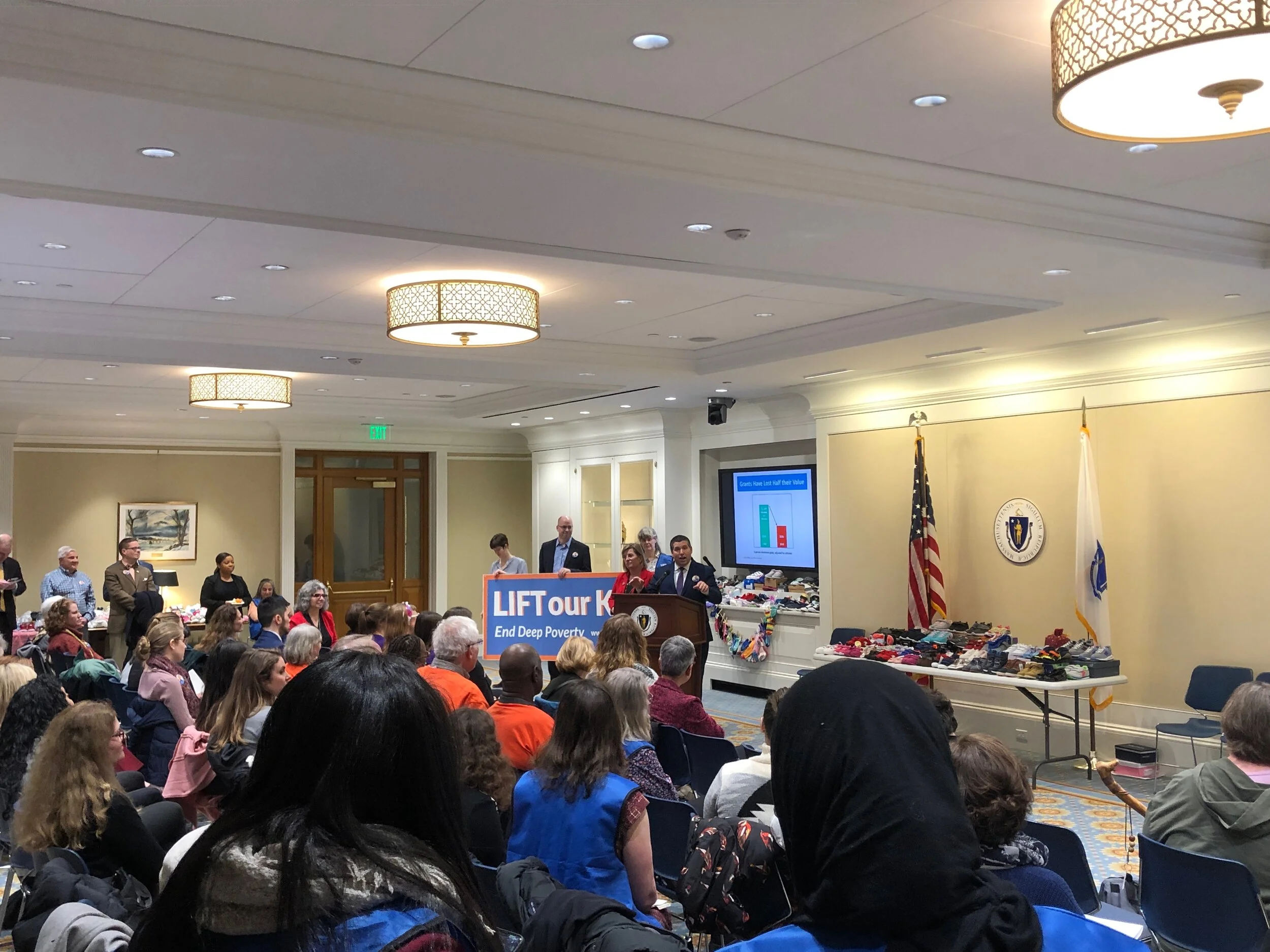
BOSTON- Last week, Senator DiDomenico, Representative Marjorie Decker, and the Lift Our Kids Coalition hosted an event at the State House to highlight the difficulties families living in deep poverty face in meeting their children’s basic needs. Senator DiDomenico and Rep. Decker are the lead sponsors of S.36/H.102, “An Act to lift kids out of deep poverty.”

Families living below 50% of the federal poverty level—currently $905 a month for a family of three— are described as living in “deep poverty.” Massachusetts Transitional Aid to Families with Dependent Children (TAFDC) benefits are a maximum of $593 a month for a family of three, therefore leaving thousands of children below the level of deep poverty. Over the years, costs have gone up, but grant levels have stayed frozen. As a result, the TAFDC grant buys only half as much as it did thirty years ago. 

Senator DiDomenico and Rep. Decker’s bill would raise assistance grants by 10% a year until they reach 50% of the federal poverty level. Under the bills, once amounts reach half the federal poverty line, the grant would adjust as the poverty level increases with inflation.

‘It is unconscionable that we have 50,000 children living so far below the federal poverty level in our Commonwealth,” said Senate DiDomenico. “Children go to school without socks, wearing worn out shoes, because their families have to pay other bills. We can—and must— do better, and we can start by passing ‘An Act to lift kids out of deep poverty’ this legislative session.”

As part of the State House event, shoes and socks were collected to benefit children in need. Following the event, coalition members The Home for Little Wanderers and Cradles to Crayons distributed donated socks and shoes to the children they serve. 

“We are incredibly fortunate to have so many co-sponsors in both the House of Representatives and the Senate,” said DiDomenico. “I would like to thank the many elected officials and advocacy organizations who attended and donated at this very successful event!”

The Lift Our Kids Coalition, comprised of 127 organizations, began in late 2016 to advocate for Senator DiDomenico and Representative Decker’s bill to repeal the state’s family cap law, which barred benefits for children conceived while or soon after the family began receiving assistance. The Legislature repealed the family cap in 2019 by a nearly unanimous vote.

Because of Senator DiDomenico, Representative Decker, and the Lift Our Kids Coalition’s efforts, about 11,000 previously excluded children are now receiving benefits. However, because benefits are so low, families continue to struggle to pay for necessities. DiDomenico, Decker, and the Coalition will now focus their efforts on S.36/H.102 to ensure that no child in the Commonwealth lives in a state of deep poverty.

In December of 2019, the Joint Committee on Children, Families, and Persons with Disabilities reported “An Act to lift kids out of deep poverty” favorably. This legislation is now pending before the Senate Committee on Ways & Means.  

###

 
Sal DiDomenico
DIDOMENICO AND SENATE COLLEAGUES APPROVE NEXT- GEN CLIMATE POLICY

BOSTON— Senator DiDomenico and his colleagues in the Massachusetts State Senate on Thursday advanced three bills that boldly tackle the contributing factors of climate change, chart one of the most aggressive courses of action against global warming in the country, and pave the way for a clean energy future for all of its residents.

An Act Setting Next Generation Climate Policy and two companion bills — one dealing with electrifying fleets and another updating energy efficiency standards for appliances  —  passed overwhelmingly and with bi-partisan support.

“We know that time is running out to take bold action on climate change, and this ambitious package is a direct response to the incredible advocacy we have heard from our constituents, especially young activists,” said Senator DiDomenico. “Combating the climate crisis is an ongoing process, but I am proud of the steps we have taken to reduce emissions and create a more sustainable future for generations to come. We as a Commonwealth owe a big thank you to Senator Michael Barrett, Senate President Karen Spilka and Senate Ways & Means Chair Michael Rodrigues for their dedication to this issue and critical work on this comprehensive climate package.”

Key provisions of the climate policy package include: 

  • Setting a statewide greenhouse gas limit for the year 2050 of “net zero” emissions.  To achieve this, An Act Setting Next-Generation Climate Policy requires the state to hit near-term limits in 2025, 2030, and every five years thereafter; set sub-limits for transportation, buildings, solid waste, natural gas distribution, and other major sectors; and make implementation plans that are “clear, comprehensive, and specific.” 

  • Establishing the Massachusetts Climate Policy Commission.  The commission would be a new, independent public watchdog to oversee government’s handling of the unfolding crisis of climate change.  Commissioners will be charged with offering a nonpartisan, science-based view of the problem as it plays out in Massachusetts with its attendant natural, economic, and demographic impacts and risks.

  • Reflecting the price of carbon.  Under the bill, the Administration would be free to choose among various market based forms of pricing carbon. Any carbon pricing mechanism must be implemented to minimize the impact on low-income households, disadvantaged communities, and vulnerable manufacturing sectors. 

  • Jumpstarting efforts to supply low-cost solar electricity to low-income communities.  To reverse the failure of state programs to incentivize solar energy projects in low-income neighborhoods, as well as spur job creation, the bill requires the Department of Energy Resources (DOER) to set aside future solar allocations for such neighborhoods.

  • Letting cities and towns adopt a “net zero” stretch energy code.  The bill allows the state to support communities that choose on their own to move away from fossil fuels as the source of heating for new buildings. 

  • Nudging natural gas utilities to adapt.  The bill authorizes utilities to test technology and pipelines that generate and transport “renewable thermal energy,” an emissions-free way to heat buildings that draws on the relative warmth of temperatures below ground. 

  • Strengthening executive branch oversight of MassSave.  The bill directs the Secretary of Energy and Environmental Affairs (EEA) to set emissions reduction goals, in advance, for each three-year plan the utilities formulate for MassSave.  It requires the DPU, at the conclusion of each three-year plan, to certify how much the plan actually contributed to meeting the Commonwealth’s greenhouse gas emission limits.

  • Tightening the alignment between MassSave and emissions limits.  The bill requires electric utilities to include an explicit value for emissions reductions whenever they calculate the cost-effectiveness of a MassSave offering.

  • Setting a deadline for converting MTBA buses to all-electric power.  An Act to Accelerate the Transition of Cars, Trucks, and Buses to Carbon Free Power directs the MBTA to limit bus purchases and leases to zero-emissions vehicles beginning in 2030, and to aim for an all-zero-emissions fleet by 2040, to reduce transportation-related emissions in city neighborhoods.

  • Offsetting the Trump Administration’s efforts to slow progress on efficient appliances.  An Act Relative to Energy Savings Efficiency updates Massachusetts appliance standards to improve energy and water efficiency standards for common household and commercial appliances, helping to conserve energy and save consumers and businesses money. 

During debate on the Senate floor, the bill was strengthened through amendments that, among others, requires regional equity in carbon pricing and ensures equity is a component of The Department of Public Utilities mission statement. 

The bills now go to the House of Representatives for consideration.


###

Sal DiDomenico
Senator DiDomenico’s Healthy Youth Act Passes MA Senate


BOSTON- The Massachusetts Senate recently passed Senator Sal DiDomenico’s bill, An Act relative to healthy youth (S.2459). This bill will ensure that Massachusetts schools electing to provide their students with sex education use age-appropriate and medically accurate curriculum that covers a comprehensive range of topics. The legislation also calls for sex education to be inclusive and appropriate for students regardless of gender, race, disability status, sexual orientation and gender identity.

“I am very proud that the Massachusetts Senate has once again reaffirmed our commitment to this commonsense healthy policy that will ensure our youth have the tools needed to protect their health and form respectful relationships,” said Senator DiDomenico. “This legislation makes it clear that sex education in the Commonwealth must be inclusive for all students and emphasize the importance and necessity of consent. I would like to thank and congratulate the many advocates who have partnered with us on this legislation and worked tirelessly to ensure Massachusetts youth have the information they need to build the bright futures they deserve— without shame or judgement.”

 Currently, when Massachusetts public schools provide their students with health education that covers sexual activity, there is no guarantee that the information provided is age-appropriate or medically accurate. This legislation changes this by requiring school districts that offer sex education to follow certain guidelines to ensure students are provided with age-appropriate, medically accurate, and comprehensive information.

The Senate passed similar versions of the Healthy Youth Act in prior sessions and this most recent version incorporates additional feedback from experts as well as advocates. This legislation does not require schools to offer sex education and also protects parents’ right to remove their children from all or part of sex education if they choose to do so — an action protected by state law. In addition, it provides districts that teach sex education curriculum with updated guidance on how to notify parents about these programs 

Notification to parents and guardians must be in English, as well as any other commonly spoken languages by parents. Districts must also have a process for parents to review the program instruction materials prior to the start of the course, if the parents request it.

Sex education programs have repeatedly been shown to work best when they emphasize the value of delaying sex, while also teaching students about the importance of protecting themselves from unintended consequences. As demonstrated by numerous studies, comprehensive sex education programs have been proven to delay the initiation of sex, increase use of contraception, lower the rates of STIs and unintended pregnancy among teens, and reduce reported levels of bullying towards LGBTQ youth in school.

A 2018 poll conducted by EMC Research showed overwhelming bipartisan support for sex education in Massachusetts, with 92% of likely voters agreeing that students should receive sex education in high school and 89% of likely voters agree that sex education should include comprehensive information, such as how to build healthy relationships and understand consent.

This bill now moves to the House of Representatives for consideration.

###