
Press Releases

Press releases and opinion editorials from the Office of Senator Sal DiDomenico.

DiDomenico & Senate Pass Bill to Establish Climate Change Adaptation Management Action Plan

BOSTON—Senator Sal DiDomenico (D-Everett) and his colleagues in the Massachusetts Senate recently passed S.2196, a bill to establish a comprehensive adaptation management action plan in response to climate change. This is the fifth time such a plan has been passed by the Senate: first in July 2014; then July 2015; followed by January 2016; and as part of the Energy Diversity bill in June 2016.

“As a Commonwealth and a nation, we can no longer wait to properly address and plan for the harmful realities of climate change,” said Senator DiDomenico, Vice Chair of the Senate Committee on Ways & Means. “This critical piece of legislation will put Massachusetts at the forefront of innovation when it comes to addressing climate change by creating a long-term, preemptive strategy that will help to protect our environment, as well as invest in our local economy and infrastructure. I am proud to have voted in favor of this bipartisan bill, and I look forward to advocating for its passage as it moves to the House of Representatives for consideration.”

A comprehensive adaptation management action plan (CAMP) would be established through a collaboration led by the Secretary of Energy and Environmental Affairs and the Secretary of Public Safety and Security. The plan would codify for the Baker Administration and all future administrations the goals, priorities and principles for resiliency, preservation, protection, restoration and enhancement of the Commonwealth’s built and natural infrastructure, based on data around existing and projected climate change impacts including temperature changes, drought, inland flooding and sea level rise. The plan would go into effect in 2018 with an update every five years.

“If gone unchecked, severe weather will wreak immense havoc on Massachusetts,” said Senate President Pro Tempore Marc R. Pacheco (D-Taunton), founding chair of the Senate Committee on Global Warming and Climate Change and original sponsor of the bill. “An adaptation plan must be codified in statute to protect our economy, public health and built and natural infrastructures. We can make our communities more resilient to the harmful effects of climate change by using our unique system of federalism to forge our own paths and organize for survival. This is the fifth time the Senate has sent resiliency legislation to the House, and it is high time that these protections make their way to the Governor’s desk.”

“The recent historically damaging and powerful hurricanes have put climate change at the forefront of international issues,” said Senate President Stan Rosenberg (D-Amherst). “We believe it is essential for us to act right now, at least on the key issues of adapting to the potential change, being ready for them and reducing emissions. Senator Pacheco’s bill once again puts Massachusetts in a leadership role on a critical issue. If we don’t plan and adapt for climate change now, we will pay dearly down the road, both in terms of potential harm to our residents and in dollars we will have to spend. This bill creates a proactive, long-term strategy to deal with the realities of our changing climate.”

“Merely reacting to climate change is not cost-effective, and it can have many advance consequences,” said Senate Minority Leader Bruce Tarr (R-Gloucester). “Having a dynamic and responsive plan can maximize the potential for success in addressing the impacts we must face on this front.”

Through the legislation, a comprehensive adaptation management action plan advisory commission would be established through the Executive Office of Energy and Environmental Affairs and the Executive Office of Public Safety and Security. The committee would be charged with producing a report that documents the preparedness and vulnerabilities in the Commonwealth’s emergency response, energy, transportation, communications, health and other systems. The group would also put forth a proposal that establishes and commits to sound management practices while compiling data on existing and projected sea-level rise using the best available science.

The legislation also establishes a regional, comprehensive climate change adaptation management plan grant program to aid in the development of regional adaptation plans. The program consists of financial assistance to municipalities for the development and implementation of comprehensive cost-effective adaptation management plans; technical planning guidance for adaptive municipalities through climate vulnerability assessments and adaptation strategy development; and development of a definition of impacts by supporting municipalities conducting climate vulnerability assessments. The grants shall be used to advance efforts to adapt land use, zoning, infrastructure, policies and programs to reduce the vulnerability of the built and natural environment to changing environmental conditions that are a result of climate change. The secretary of energy and environmental affairs shall also develop and implement an outreach and education program about climate change and its effects in low-income and urban areas.

The bill also creates a coastal buy-back program authorizing the Executive Office of Energy and Environmental Affairs to acquire, by voluntary purchase, property abutting areas subject to tides or barrier beaches or located in velocity zones of flood plain areas that contain structures repeatedly damaged by severe weather. Prior to the acquisition of land under this section, the executive office shall, after consultation with the municipality in which the land is located, develop a conservation and recreation management plan and a coastal erosion mitigation and management plan.

The bill now goes to the House of Representatives for consideration.

###
Sal DiDomenico
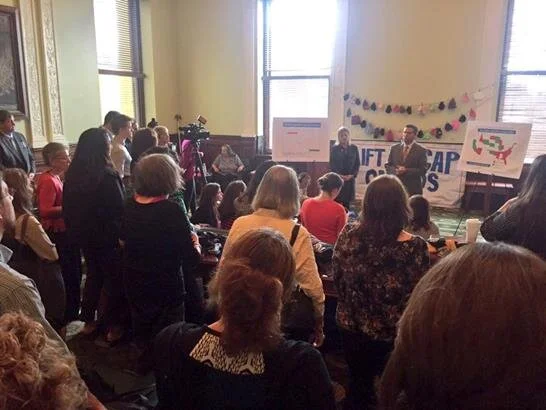
Sen. DiDomenico, Rep. Decker & the Campaign to Lift the Cap on Kids Host Caps and Mittens Day at the State House
Senator DiDomenico addresses the crowd at Caps & Mittens Day, urging action on legislationto lift the Cap on Kids.

Senator DiDomenico addresses the crowd at Caps & Mittens Day, urging action on legislation

to lift the Cap on Kids.

Senator DiDomenico joins Irene Cardillo of the Grace Food Pantry of Everett, who brought a large donation of winter coats, hats, and mittens to the Cap & Mittens event.

Senator DiDomenico joins Irene Cardillo of the Grace Food Pantry of Everett, who brought a large donation of winter coats, hats, and mittens to the Cap & Mittens event.

BOSTON – Senator Sal DiDomenico (D-Everett), Representative Marjorie Decker (D-Cambridge), and members of the Campaign to Lift the Cap on Kids recently held Caps and Mittens Day at the State House as part of an ongoing effort to raise awareness about the need to Lift the Cap on Kids in Massachusetts. Senator DiDomenico and Representative Decker are the respective Senate and House sponsors of legislation to ‘Lift the Cap on Kids.’

The Cap on Kids – also called the “family cap” -- denies benefits to children conceived while – or soon after – the family began receiving benefits. As a result of the Cap on Kids, Massachusetts does not provide benefits for 8,900 children living in deep poverty. Their parents struggle to provide even the most basic essentials for their children, including keeping their babies safe and healthy. With winter approaching, the need for winter coats, hats, and gloves is an additional cost that is often out of reach for low-income families.

“The Cap on Kids is hurting families, and it’s time we put an end to this ineffective policy,” said Senator Sal DiDomenico, Vice Chairman of the Senate Committee on Ways & Means. “We should be doing everything we can to help families provide their children with the things they need. Low-income families face difficult decisions every day. Making sure they have winter hats and mittens to keep them warm should not be one of them.”

“We have the opportunity to reverse a policy that excludes children from state assistance they need and qualify for, with the exception of children who happen to be born after their parents received badly needed support from the state,” said Representative Marjorie Decker. “Parents don’t choose which child to feed, keep warm with hats or mittens, or diaper. This law is hurting families that meet all of our standards of being desperately in need. If we understand their reality then we will move forward to reversing this harmful law.  I have confidence that we are have a lot of growing support from all over the Commonwealth and in the Legislature.”

The Campaign to Lift the Cap on Kids has been collecting winter hats and mittens for the event to demonstrate this harsh policy’s impact on low income children and families.  All of the donated hats and mittens will go to Cradles to Crayons and the Home for Little Wanderers, who will distribute them to families in need.

“We are grateful for the continued leadership of Representative Decker and Senator DiDomenico as we work to Lift the Cap on Kids in Massachusetts. It’s time we stop hurting families and give them the resources they need to thrive,” said Deborah Harris of Massachusetts Law Reform Institute, a lead member organization of the Campaign to Lift the Cap on Kids. 

“Lifting the Cap on Kids would make a huge difference in the lives of so many families,” said Naomi Meyer, Greater Boston Legal Services, on behalf of the Campaign to Lift the Cap on Kids. “Every day, we see families struggling to provide basic essentials for their children, and it doesn’t have to be that way.”

“The cap on kids hurts the most vulnerable members of our commonwealth, young kids born to extremely low income parents. It’s an antiquated policy that has no place in Massachusetts today, when so many families across our state are struggling simply to meet their most basic needs,” said  Rebekah Gewirtz, Executive Director, National Association of Social Workers – MA Chapter. “We should focus our efforts on fighting poverty, not the poor.”

Massachusetts is one of only 17 states - including Arkansas, Mississippi, and North Carolina – that still has a Cap on Kids. An Act to lift the cap on kids was recently given a favorable report by the Joint Committee on Children, Families, and Persons with Disabilities and is currently pending before the Senate Committee on Ways & Means.

###

Sal DiDomenico
DiDomenico Votes to Address the Skills Gap and Help Unemployed Workers

Legislation Funds Workplace Competitiveness Trust Fund and renames grants after Senator Donnelly


BOSTON- Last week, Senator Sal DiDomenico joined his Senate colleagues in unanimously voting to engross An Act to Diversify the Use of the Workforce Training Fund to Support the Workforce Competitiveness Trust Fund. The legislation, originally filed by the late Senator Kenneth J. Donnelly, and since championed by his successor Senator Cindy Friedman, will ensure a sustainable, predictable source of annual funding for the Workforce Competitiveness Trust Fund (WCTF). 

The WCTF provides high impact job training grants designed to support unemployed and under-employed workers while helping employers across the Commonwealth hire the skilled workers they need to grow. Furthermore, grants issued from the fund are to be re-named the Senator Kenneth J. Donnelly Workforce Success Grants.

“Senator Ken Donnelly was a great friend and a true champion for the working men and women of the Commonwealth, and renaming the Workforce Competitiveness Trust Fund after him is a fitting tribute to his legacy as a strong advocate for economic opportunity,” said Senator DiDomenico. “I am very proud to support this critical piece of legislation that will strengthen the Commonwealth’s workforce development system and help to put more people on a path to economic stability.”

This bill would allow up to 5% of the state’s Workforce Training Fund, an approximately $22M annual fund supported by employer contributions for incumbent worker training, to be used for the WCTF, a proven sector-based training model that has served hundreds of employers with qualified, skilled employees.

The WCTF was created by the economic stimulus act of 2006 and administered by Commonwealth Corporation on behalf of the Executive Office of Labor and Workforce Development. The WCTF funds regional sector training partnerships across the state with the goal of placing unemployed and underemployed workers in jobs that are in demand. Grants from the fund bring together employers in a particular sector, workforce investment boards, career centers, vocational technical schools, community colleges, and workforce training providers. 

The bill also ensures that WCTF grants are performance-based, with 50% paid upon enrollment in the program and the remaining 50% to be paid contingent on job placement and retention outcomes.

A broad coalition of stakeholders has advocated for this legislation, including the business community, workforce boards, labor unions, job training providers, and advocates for low-income workers and their families.

Senator Kenneth J. Donnelly served for 37 years as a firefighter and for 8 years as a state senator. He was a staunch believer in the role of unions and government to protect workers, and he was well known for his efforts to advance justice and equality for all people no matter their race, religion, national origin, or sexual orientation. During his time in the Senate he advocated fiercely for funding for workforce training for unemployed and underemployed workers.  

The bill now moves to the House of Representatives for consideration.

###

Sal DiDomenico